Your Garage is Tougher on Lights Than You Think. Here’s How to Choose LEDs That Last.


Published: Jun 19, 2026 | Updated: Jul 28, 2026

You flick the switch, and the familiar hum of your garage light is replaced by a sad, weak flicker. Or worse, nothing at all. If you’ve ever replaced a garage light bulb only to have it fail a year later, you’re not alone. It’s a common frustration, but the bulb might not be the real problem.

The real culprit? Your garage itself.

Uninsulated garages face a daily battle with fluctuating temperatures, condensation, and a constant barrage of dust. These aren’t just minor inconveniences; they’re silent killers for standard light fixtures. Before you buy another “super bright” LED that promises the world, it’s time to understand the one feature that matters most for durability: its IP rating.

Think of it as a resilience score. Getting this right means you stop replacing lights and start enjoying a bright, reliable garage for years to come.
Foundation: IP Ratings Made Simple


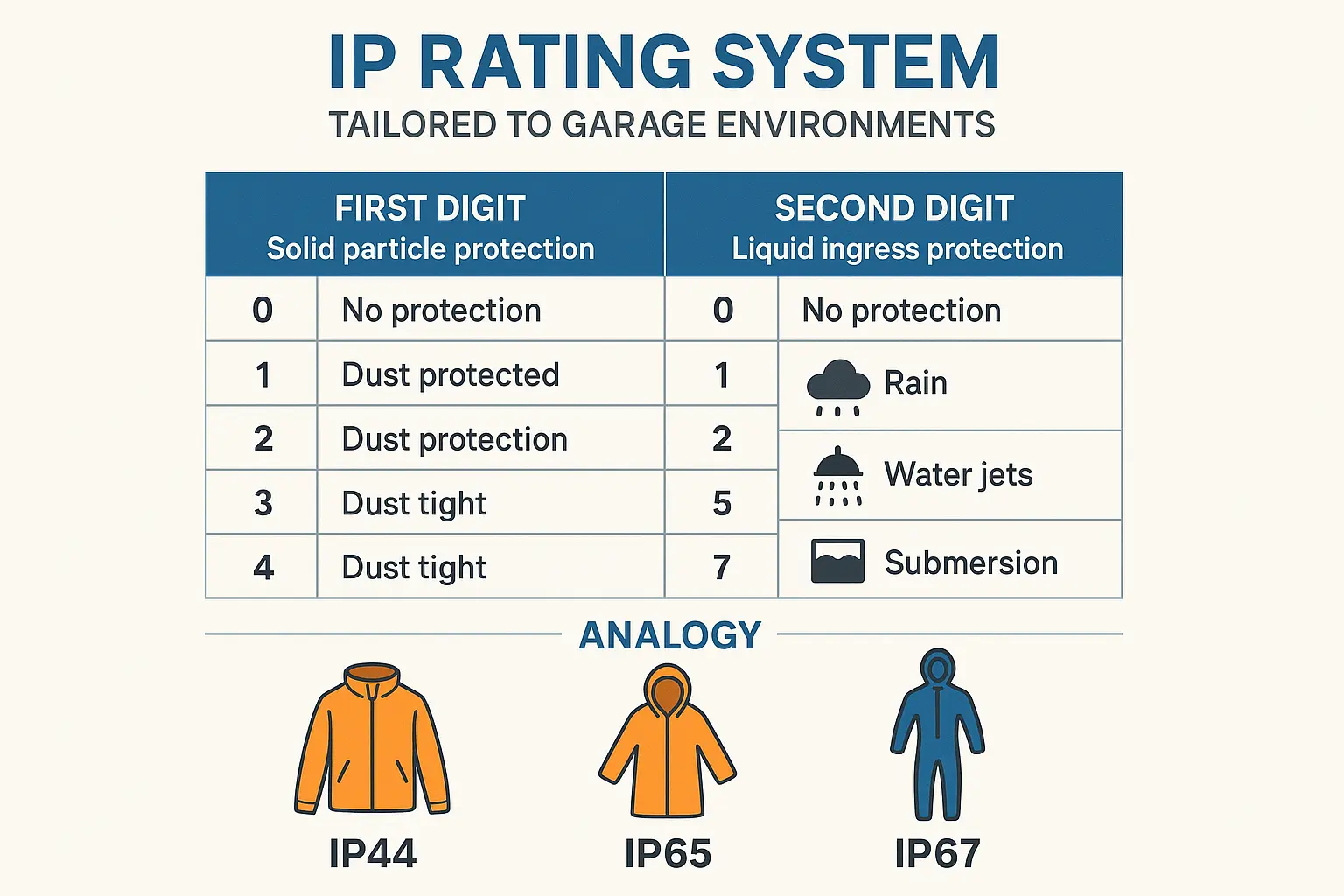
A visual guide comparing IP44, IP65, and IP67 ratings with icons representing light mist, water jets, and submersion, respectively.
When you start shopping for durable lights, you’ll see a code that looks like “IP65.” This isn’t just technical jargon; it’s the key to your light’s survival.
IP stands for Ingress Protection, and it’s a universal standard that rates how well a fixture is sealed against two things: solids (like dust) and liquids (like water).

The two numbers after “IP” tell the whole story:

First Digit (Solids): Rates protection against solid objects, from a finger (low rating) to fine dust particles (high rating). It ranges from 0 (no protection) to 6 (completely dust-tight).

Second Digit (Liquids): Rates protection against moisture, from dripping water (low rating) to high-pressure jets or even full submersion (high rating). It ranges from 0 (no protection) to 8 (suitable for continuous submersion).

The easiest way to think about it is with an analogy:

IP44 is like a windbreaker: It can handle a light splash or mist but won’t hold up in a real downpour.

IP65 is like a quality raincoat: It’s built to withstand being sprayed with a hose from any direction.

IP67 is like a diving suit: It can be dropped in a puddle or temporarily submerged without any issue.

For a garage, a rating of “IP20” (common for indoor household lights) is an invitation for dust and moisture to get inside and destroy the sensitive electronics.

Building: The 3 Garage Killers (And How to Spot Them)


There are moments and situations when garage doors must be replaced or repaired. It faces unique environmental challenges that demand a tougher class of fixture. Here’s how to identify the specific “killers” in your space.

1. Moisture: The Difference Between Damp and Wet

This is the single most misunderstood part of choosing a garage light. “Moisture” isn’t a one-size-fits-all problem.

Damp Conditions: Does your uninsulated garage get winter garage door issues? Do you see condensation forming on windows, tools, or the car? That’s a damp environment. The air itself is heavy with moisture that can seep into unsealed electronics over time. For this, you need a light that is, at a minimum, damp-rated.

Wet Conditions: This involves direct water contact. Do you wash your car inside the garage? Do you spray down the floors with a hose to clean them? This is a wet environment. A damp-rated light won’t survive. You need a light with a high liquid IP rating (IPX5 or greater) that can handle direct water jets.

2. Dust: More Than Just a Nuisance

Dust isn’t just messy; it’s an insulator. When it coats a light fixture, it traps heat, which can shorten the lifespan of the LED driver.

Ambient Dust: Every garage has some level of dust from cars, storage, and the outdoors.

Hobby Dust: If your garage is also your workshop for woodworking, sanding, or cutting drywall, you’re dealing with a much bigger threat. Fine particulates can work their way into the tiniest crevices of an unsealed light, causing it to overheat and fail prematurely. For this, you need a light that is fully “dust-tight” (IP6X).

3. Cold: The LED’s Surprising Advantage

Here’s some good news: unlike fluorescent tubes that can struggle to start in the cold, LEDs actually perform better in chilly temperatures. The cold helps dissipate heat, which is the primary enemy of an LED’s longevity. However, the fixture’s housing and driver still need to be designed to handle the temperature swings and associated condensation, which brings us right back to the importance of moisture protection.

Mastery: The Garage Audit & Recommendation Engine


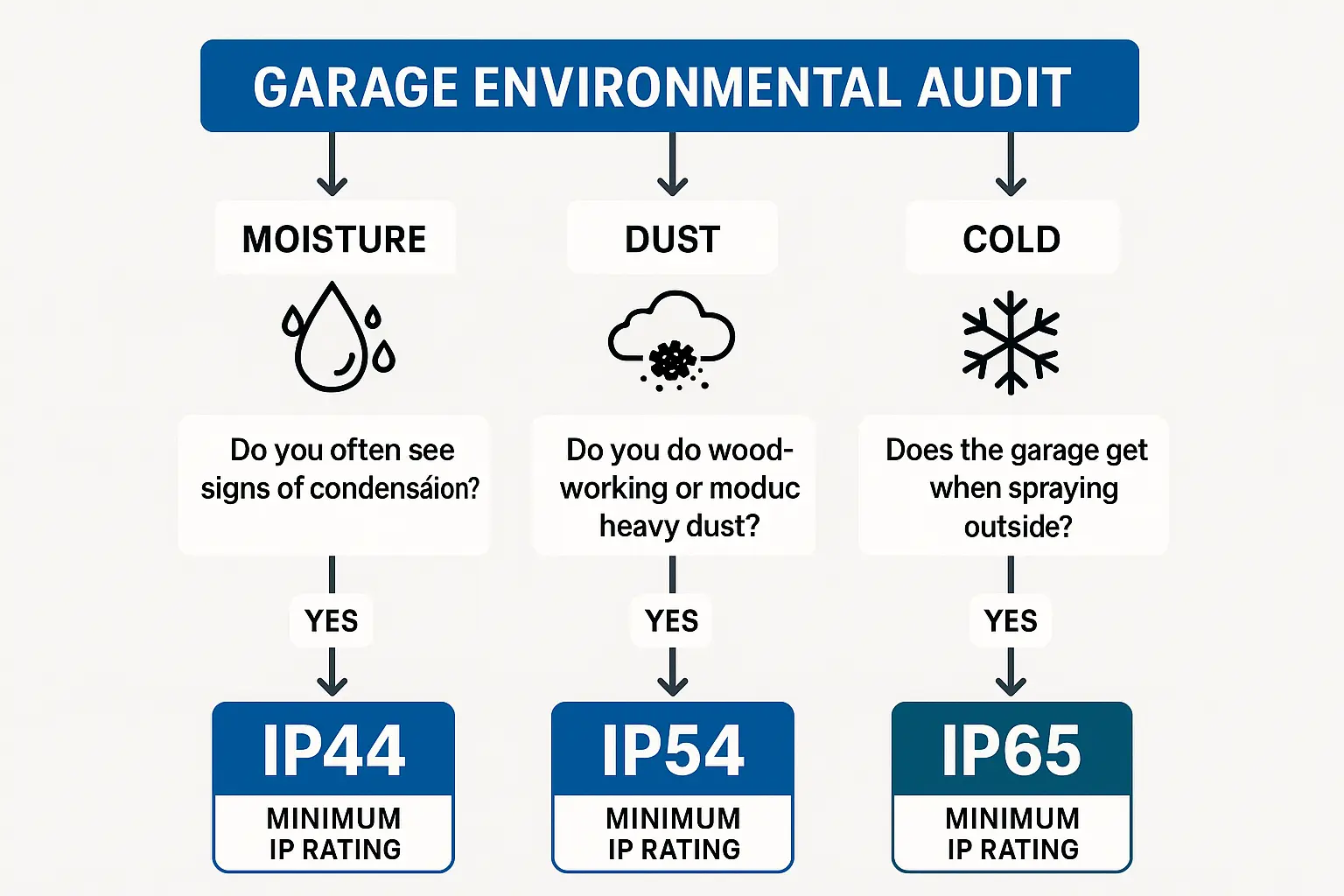
A flowchart guiding users through assessing their garage's dampness, dust levels, and cleaning habits to determine the appropriate IP rating for their LED lighting.
Stop guessing. Instead of picking a light and hoping for the best, let’s diagnose your garage’s specific needs. Answer these three simple questions to find the perfect IP rating for your space.
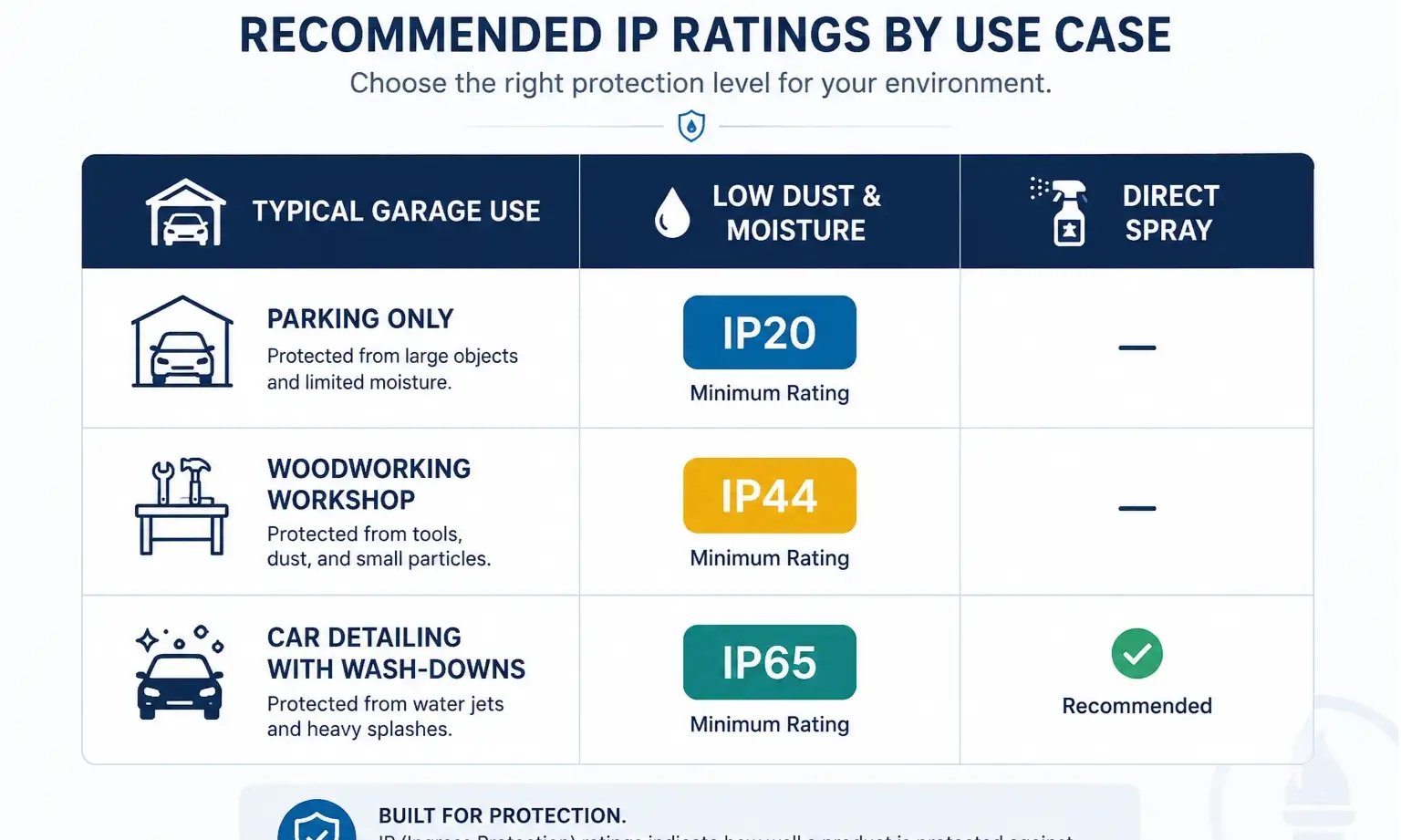
Once you’ve audited your environment, use this chart to match your activities to a minimum recommended IP rating.

Garage Use Case Primary Hazards Minimum IP Rating Why It’s the Right Choice
Simple Parking & Storage Ambient Dust, Winter Condensation IP44 Protects against solid objects larger than 1mm and water splashes from any direction. Perfect for basic damp conditions.
DIY & Home Projects Moderate Dust, Occasional Spills IP54 Offers enhanced dust protection while still handling water splashes. Good for a multi-purpose space.
Dedicated Woodworking/Metalworking Heavy, Fine Dust, Condensation IP64 / IP65 IP6X is critical here. It’s completely dust-tight, preventing overheating. The ‘5’ for liquids handles moisture and cleanup.
Car Detailing & Wash Bay High-Pressure Water Jets, Dust IP65 The ‘5’ rating for liquids is non-negotiable. It ensures the fixture can withstand direct spray from a hose.
Ultimate Durability All of the above, including floor washing IP66 / IP67 Built for powerful water jets (IP66) or temporary submersion (IP67). This is overkill for most but ideal for intense use.

Action: Completing Your Lighting Plan


A step-by-step graphic showing the process for a garage lighting upgrade: 1. Assess Durability (IP Rating), 2. Calculate Brightness (Lumens), 3. Choose Color Temp (Kelvin), 4. Select Fixture & Layout.
Once you’ve determined the right durability rating, you can finally focus on the fun part: light quality.
1. Assess Durability Needs First (You just did!): You’ve identified your required IP rating. This is the foundation of a lasting upgrade.
2. Calculate Brightness (Lumens): For general garage use, aim for 50 lumens per square foot. For workshops, increase that to 80-100 lumens per square foot to ensure your work area is well-lit.3. Choose Color Temperature (Kelvin): A color temperature of 4000K to 5000K provides a crisp, neutral-to-cool white light that mimics daylight, ideal for visibility and detailed tasks.

4. Select Fixture and Layout: Consider strip lights for even, whole-room coverage, or adjustable spotlights to focus on specific workbenches. A good plan often uses both. A well-thought-out layout can be enhanced with smart lighting solutions for your overhead garage door, adding convenience and security.

Frequently Asked Questions


What’s the minimum IP rating I need for a garage?

It depends entirely on your garage’s conditions and how you use it. For a basic, dry garage that just sees some condensation, IP44 is a reasonable starting point. However, if you create any dust or wash your floor, you should start at IP65. Use the audit above to be sure.

Are all LED lights good for cold weather?

While LED technology itself works well in the cold, the entire fixture (including the driver and housing) must be rated for it. A low-quality fixture can still fail in extreme cold or due to condensation during temperature swings. Always check the manufacturer’s specified operating temperature range.

Do I really need a special light for my dusty workshop?

Absolutely. A standard light fixture with a low IP rating (like IP20) has openings that allow fine sawdust to get inside. This dust blankets the electronics, traps heat, and can lead to a fire hazard or premature failure. A dust-tight IP6X rating is a crucial safety and longevity feature for any workshop.

Can I connect my new lights to my garage door opener?

Many modern lighting setups can be integrated with your garage’s systems. This can range from simple motion detectors to more advanced setups. For homeowners interested in creating a fully connected space, integrating smart lighting with your garage door opener is an excellent next step to explore.

Your Path to a Brighter Garage


Choosing the right light for your garage is about more than just brightness; it’s about investing in a solution that’s tough enough to thrive in a challenging environment. By taking a few moments to assess your space and understand what an IP rating really means, you can move beyond the cycle of replacing failed bulbs and install a lighting system that is safe, reliable, and built to last.

Upgrading your lighting is one of the most impactful improvements you can make. By putting durability first, you ensure your investment pays off for years to come. For more ideas on modernizing your space, learn how smart lighting for overhead garage doors can transform your daily routine.

Frequently Asked Questions


What does an IP rating mean for garage LED lights?

IP (Ingress Protection) rating indicates how well a light fixture is protected against dust and water. The first digit represents protection against solid objects like dust, and the second digit represents protection against liquids like moisture or water.

What is the best IP rating for a damp or uninsulated garage?

For damp, dusty, or uninsulated garages prone to condensation, an IP65 rating is generally recommended. This rating ensures the LED light fixture is completely dust-tight and highly protected against water and moisture.

Do I need IP-rated lights if my garage is heated and completely dry?

If your garage is fully climate-controlled, insulated, and dry, standard indoor LED lights (typically IP20) are usually sufficient. However, if you frequently do woodworking or other dusty projects, upgrading to a higher IP rating for dust protection is still a smart choice.

Contact / Request a Call