You’re thinking about replacing your own garage door springs. You’re capable, you’ve watched a few videos, and it seems like a straightforward way to save a few hundred dollars. The online guides make it look manageable, a series of simple steps. But the most critical safety factor—the one that separates a successful repair from a trip to the emergency room—isn’t about the spring itself. It’s about the piece of steel you hold in your hand.
Most “danger” warnings focus on the spring’s power, which is absolutely a real concern. However, they miss the more immediate point of failure: the tools. This guide isn’t here to scare you with worst-case scenarios. Instead, we’re going to have a practical talk, like a knowledgeable friend over coffee, about the physics of why common DIY tools are mechanically guaranteed to fail under the unique stress of a torsion spring.
Why DIY Garage Door Spring Tools Fail
Published: Feb 4, 2026 | Updated: Jul 28, 2026
The Science of Stored Energy: What's Happening in That Spring?
Before we talk about tools, we need to respect the force they’re up against. A torsion spring doesn’t just help lift your heavy garage door; it does nearly all the work. When the door is closed, the springs are wound incredibly tight, storing a massive amount of potential energy.
Think of it like a tightly wound catapult or a loaded mousetrap, but on a much larger and more powerful scale. For a standard 16-foot residential garage door, the springs are holding hundreds of foot-pounds of torque. The process of winding or unwinding them involves manually controlling that immense force. While many people understand the general risks involved, the question of why are garage door springs dangerous often comes down to this massive, instantly released energy when something goes wrong. And the “something” that most often goes wrong is the tool being used.
Think of it like a tightly wound catapult or a loaded mousetrap, but on a much larger and more powerful scale. For a standard 16-foot residential garage door, the springs are holding hundreds of foot-pounds of torque. The process of winding or unwinding them involves manually controlling that immense force. While many people understand the general risks involved, the question of why are garage door springs dangerous often comes down to this massive, instantly released energy when something goes wrong. And the “something” that most often goes wrong is the tool being used.
The Tool Dilemma: Professional Winding Bars vs. Common Substitutes
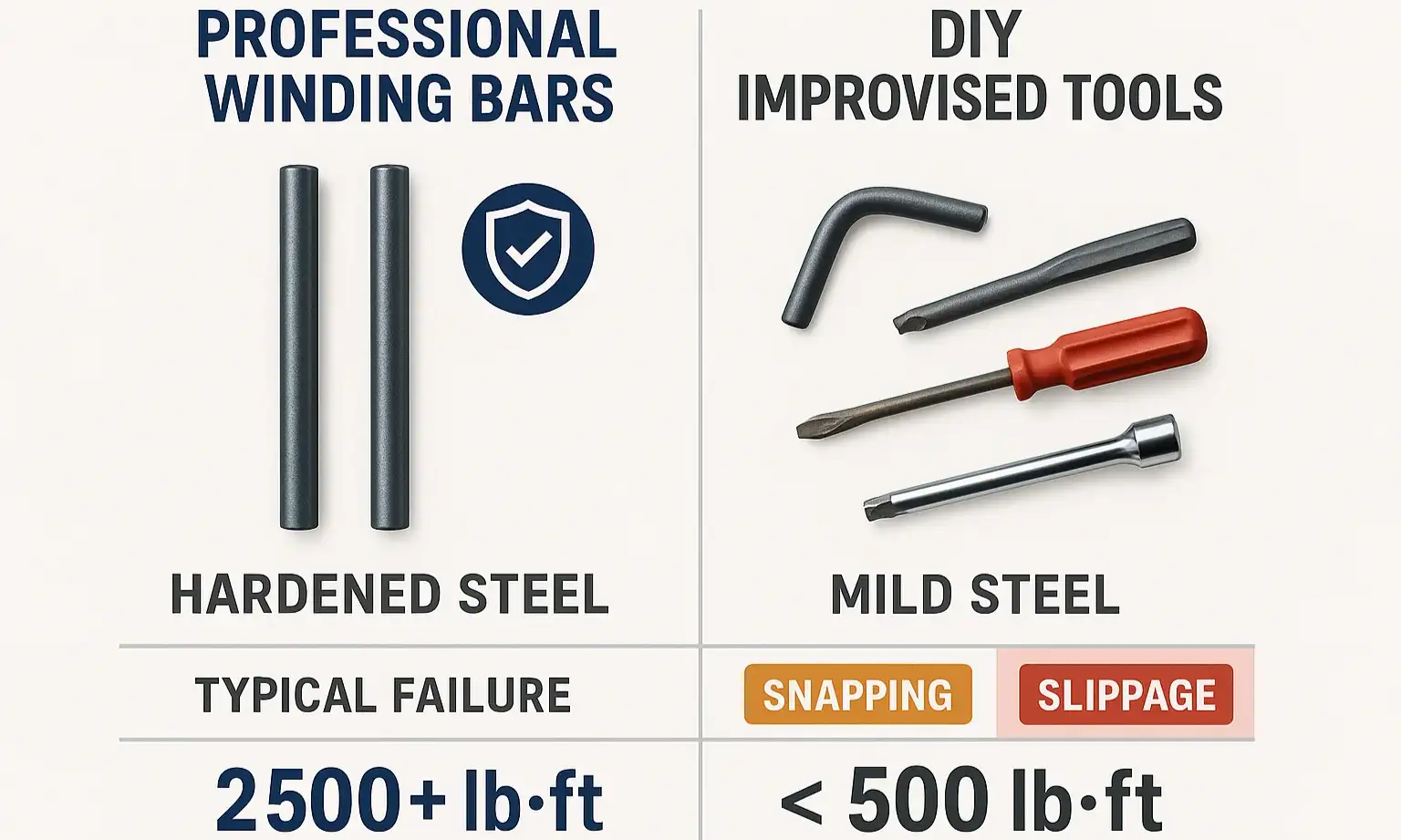
This is the core of the issue. A professional uses a specific tool for a specific job. A DIYer, trying to save money, often looks for a substitute that looks like it should work. Here’s why those substitutes are a recipe for disaster.
Professional Tool: Hardened Steel Winding Bars
A true winding bar isn’t just any steel rod. It’s specifically engineered from hardened steel, designed to withstand immense rotational force—or torsion—without bending or shearing. They are cut to a precise length to provide the necessary leverage without being unwieldy, and their diameter fits perfectly into the winding cone of the spring.
Common Substitute #1: Screwdrivers
It’s tempting. A long, thick screwdriver seems like it would fit. But it’s the absolute worst tool for the job.
Common Substitute #2: Hardware Store Steel Rods or Rebar
This is the most deceptive and dangerous substitute. Many online guides even suggest buying a steel rod from a big-box hardware store. The problem is a fundamental difference in materials.
Common Substitute #3: Socket Wrenches and Ratchets
Using a large ratchet with a long extension might seem like a clever solution for leverage. However, these tools are built for a different kind of force.
The "Aha" Moment: Visualizing the Physics of Failure
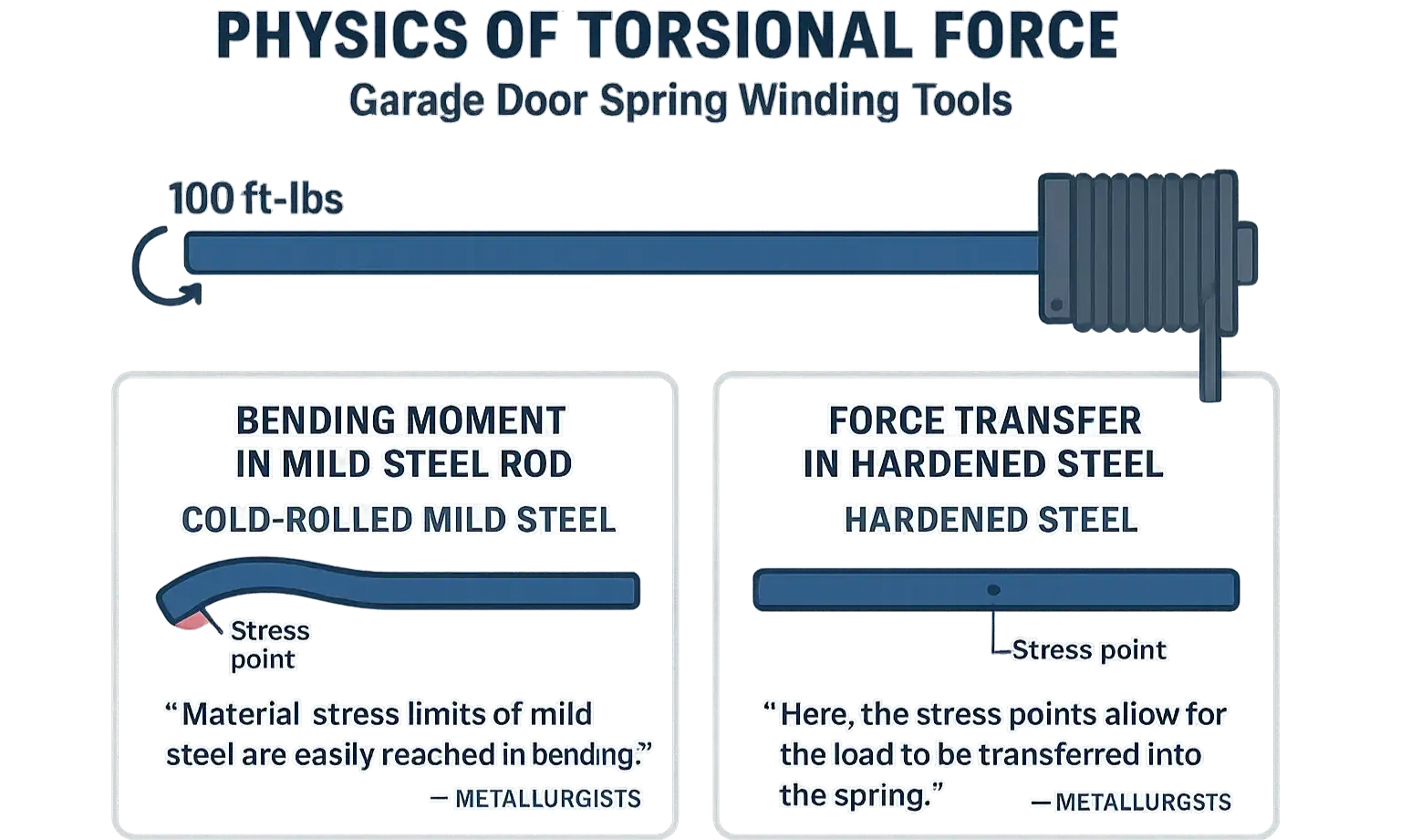
The disconnect happens because we confuse general strength with task-specific strength. Using a soft steel rod to wind a torsion spring is like trying to stop a car with bicycle brakes. The materials are simply not rated for the type of force they are being subjected to.
Torsional force is a twisting force. A winding bar needs to resist this twisting without deforming. Leverage is simply using a lever to multiply force. While you need leverage, the tool itself must be able to handle the underlying torsion. Mild steel can’t.
When a soft steel rod bends even slightly, it changes the geometry of your grip. The force is no longer being applied perpendicular to the rod, causing your hand to slide off. This is the precise moment of catastrophic failure that leads to the severe injuries everyone warns about. Understanding the mechanics of garage door spring winding is as much about the tool’s material science as it is about the winding process itself.
Torsional force is a twisting force. A winding bar needs to resist this twisting without deforming. Leverage is simply using a lever to multiply force. While you need leverage, the tool itself must be able to handle the underlying torsion. Mild steel can’t.
When a soft steel rod bends even slightly, it changes the geometry of your grip. The force is no longer being applied perpendicular to the rod, causing your hand to slide off. This is the precise moment of catastrophic failure that leads to the severe injuries everyone warns about. Understanding the mechanics of garage door spring winding is as much about the tool’s material science as it is about the winding process itself.
The Safe Decision: Two Paths Forward
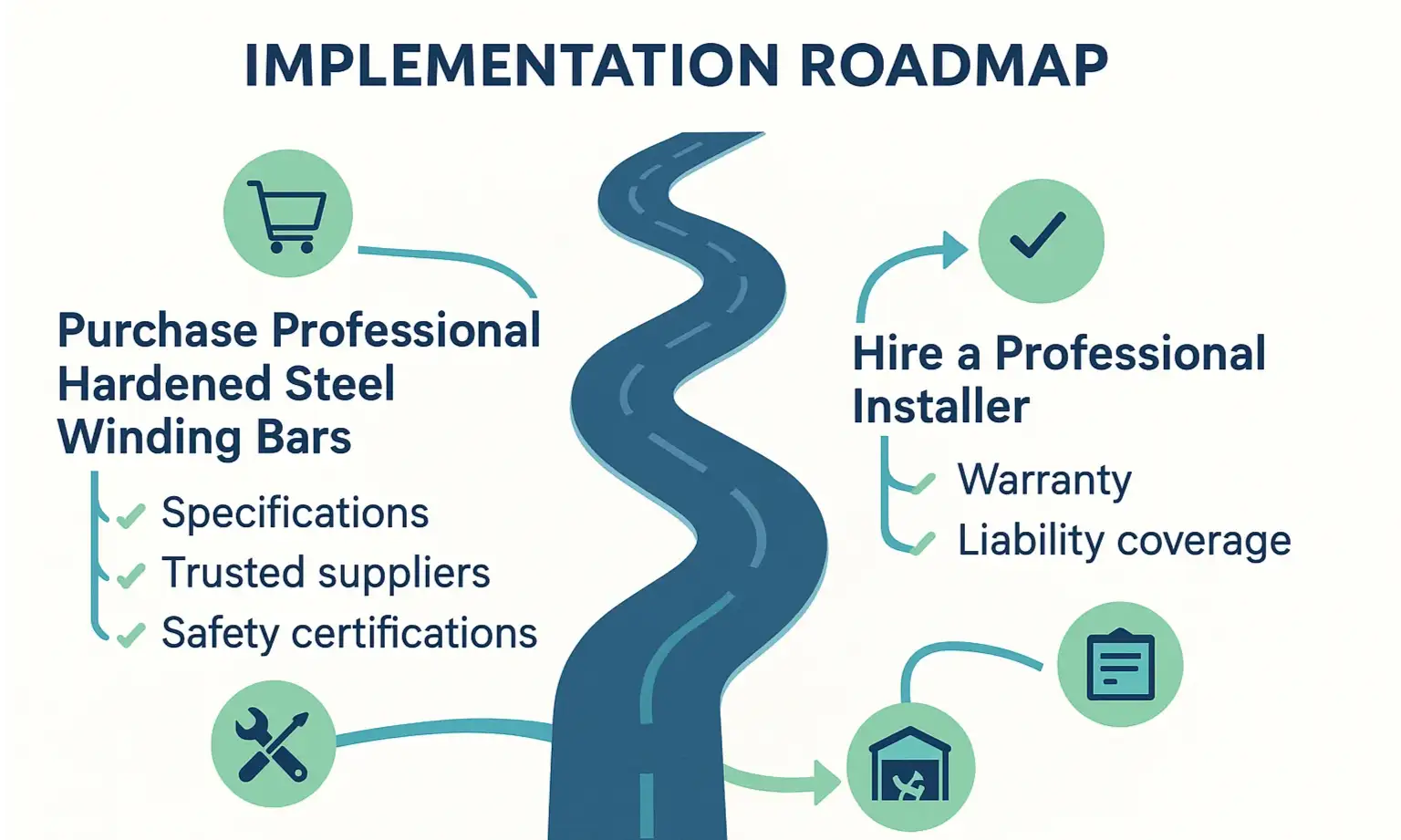
Now that you understand the mechanics of why specific tools fail, you see that the warnings aren’t just about being careful—they’re about using equipment that is physically capable of handling the load. This leaves you with two safe choices for a broken garage door spring repair.
Using anything other than professional-grade winding bars isn’t taking a risk—it’s creating a near-certainty of mechanical failure.
Frequently Asked Questions
Why can’t I just use a long piece of rebar? It seems strong.
Rebar is designed to add tensile strength to concrete, meaning it’s strong when pulled. It is made of soft steel and is not designed to resist the intense twisting (torsional) force of a spring. It will bend, causing your grip to slip.
What is a winding bar actually made of?
Professional winding bars are made from high-tensile, hardened steel. This material has been heat-treated to give it the rigidity needed to withstand torsional force without bending or breaking.
At what point does a hardware store steel rod bend?
It begins to bend almost immediately when subjected to the full torque of a garage door spring. The bend may be slight at first, but it quickly becomes pronounced enough to cause a loss of control. The failure is not a matter of “if,” but “when.”
Are the “DIY kits” sold online safe?
Some kits come with proper winding bars, but many do not. Always verify that the bars included are described as “hardened steel.” If the description is vague or just says “steel rods,” assume they are inadequate mild steel.
Your Next Step in Garage Door Safety
Understanding the “why” behind tool safety empowers you to make a truly informed decision. The goal is a working garage door, not a preventable accident. Whether you choose to invest in the right equipment or call in an expert, you’re now equipped with the critical knowledge that many DIY guides leave out.
Once your springs are safely addressed, focusing on regular upkeep can prevent future issues. Learning more about proper garage door spring maintenance is the best way to extend their lifespan and ensure your door continues to operate safely and reliably.
Once your springs are safely addressed, focusing on regular upkeep can prevent future issues. Learning more about proper garage door spring maintenance is the best way to extend their lifespan and ensure your door continues to operate safely and reliably.
Frequently Asked Questions
Why can't I just use a long piece of rebar? It seems strong.
Rebar is designed to add tensile strength to concrete, meaning it's strong when pulled. It is made of soft steel and is not designed to resist the intense twisting (torsional) force of a spring. It will bend, causing your grip to slip.
What is a winding bar actually made of?
Professional winding bars are made from high-tensile, hardened steel. This material has been heat-treated to give it the rigidity needed to withstand torsional force without bending or breaking.
At what point does a hardware store steel rod bend?
It begins to bend almost immediately when subjected to the full torque of a garage door spring. The bend may be slight at first, but it quickly becomes pronounced enough to cause a loss of control. The failure is not a matter of "if," but "when."
Are the "DIY kits" sold online safe?
Some kits come with proper winding bars, but many do not. Always verify that the bars included are described as "hardened steel." If the description is vague or just says "steel rods," assume they are inadequate mild steel.