You’ve spent months curating the perfect look for your modern home. The clean lines of the roof, the texture of the siding, the minimalist window frames—every detail works in harmony. But then there’s the garage door. It’s a vast surface, often covering up to 40% of your home’s facade, yet it can feel like an afterthought.
Choosing the right garage door isn’t just about function; it’s a defining architectural decision. For modern homes, the choice often boils down to two dominant styles: flush panel and recessed panel. While they might seem similar at first glance, the difference between them is the difference between a home that looks good and a home that looks designed.
This guide is your coffee-shop conversation with an expert. We’ll break down what these styles are, why they matter, and how to choose the one that elevates your home’s modern aesthetic from ordinary to exceptional.
Flush Panel vs. Recessed Panel Overhead Garage Doors
Published: Jan 16, 2026 | Updated: Jul 28, 2026
Beyond Flat or Textured: Defining the Two Pillars of Modern Design
Before we dive into architectural pairings, let’s establish a clear foundation. The primary difference between flush and recessed panels lies in how they treat the door’s surface and, consequently, how they play with light and shadow.
The Flush Panel: A Statement in Simplicity
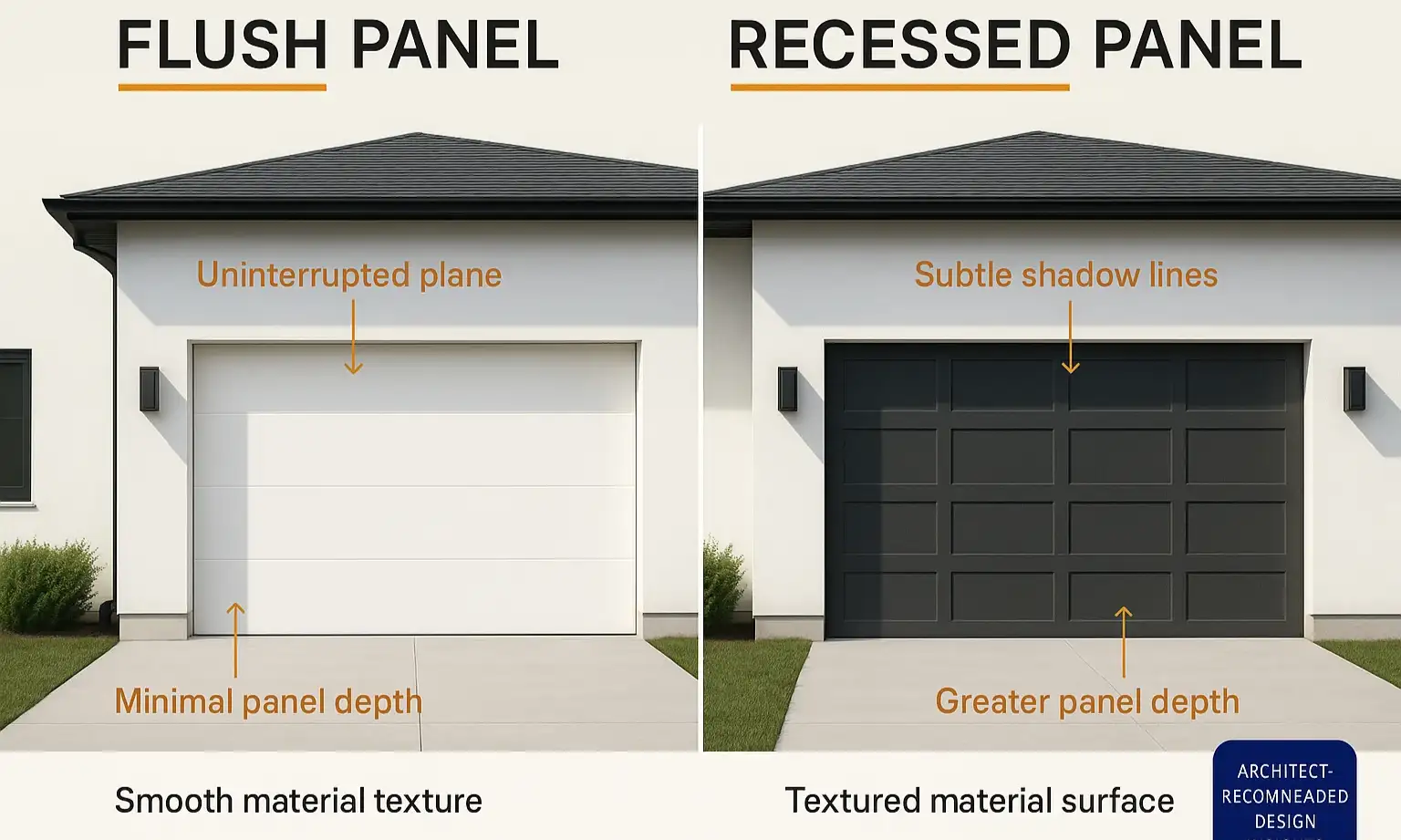
Imagine a single, smooth, unbroken surface. That’s the essence of a flush panel garage door. There are no indentations, no raised edges, just a clean, monolithic plane. This design choice is intentional and powerful.
The Recessed Panel: Depth Through Discipline
A recessed panel door introduces subtle geometry. It features clean, rectangular indentations (or recesses) across the door’s surface. Unlike traditional raised panels that push outward, these panels are set back, creating crisp shadow lines.
Side-by-Side Visual Comparison
The best way to understand the difference is to see it. Notice how the flush panel on the left blends seamlessly into the facade, while the recessed panel on the right creates subtle, defining shadows that add a layer of texture.
The Aesthetic Deep Dive: Why Panels Matter for Modern Homes
Now for the “aha moment.” The right panel style doesn’t just match your home; it amplifies its core design language. Understanding which door pairs with specific architectural styles is key.
Best for Sleek Minimalism (Scandinavian, Japandi): Flush Panels
If your home’s design is guided by the principle of “less is more,” the flush panel is your answer. In Scandinavian or Japandi architecture, the beauty lies in the purity of form and material. A flush panel door respects this by not competing for attention. It becomes a quiet, supportive element that reinforces the home’s clean, uninterrupted lines.
Best for Textured Modernism (Modern Farmhouse, Industrial): Recessed Panels
Homes that blend modern lines with rustic or industrial materials—like a Modern Farmhouse with board-and-batten siding or an Industrial design with exposed brick—benefit from the subtle texture of recessed panels. The clean, geometric shadow lines of the panels complement the texture of the siding or brick without feeling busy or traditional. It’s a perfect bridge between clean modernism and tactile materials.
The Mid-Century Modern Chameleon: A Case for Both
Mid-Century Modern (MCM) design is a fantastic case study because both styles can work beautifully, depending on your goal.
This choice highlights a key principle: the door should be in conversation with other elements of your home, from window trim to siding. Exploring different garage trim ideas can further unify the look.
Mastery: Materials, Construction & The Details That Matter
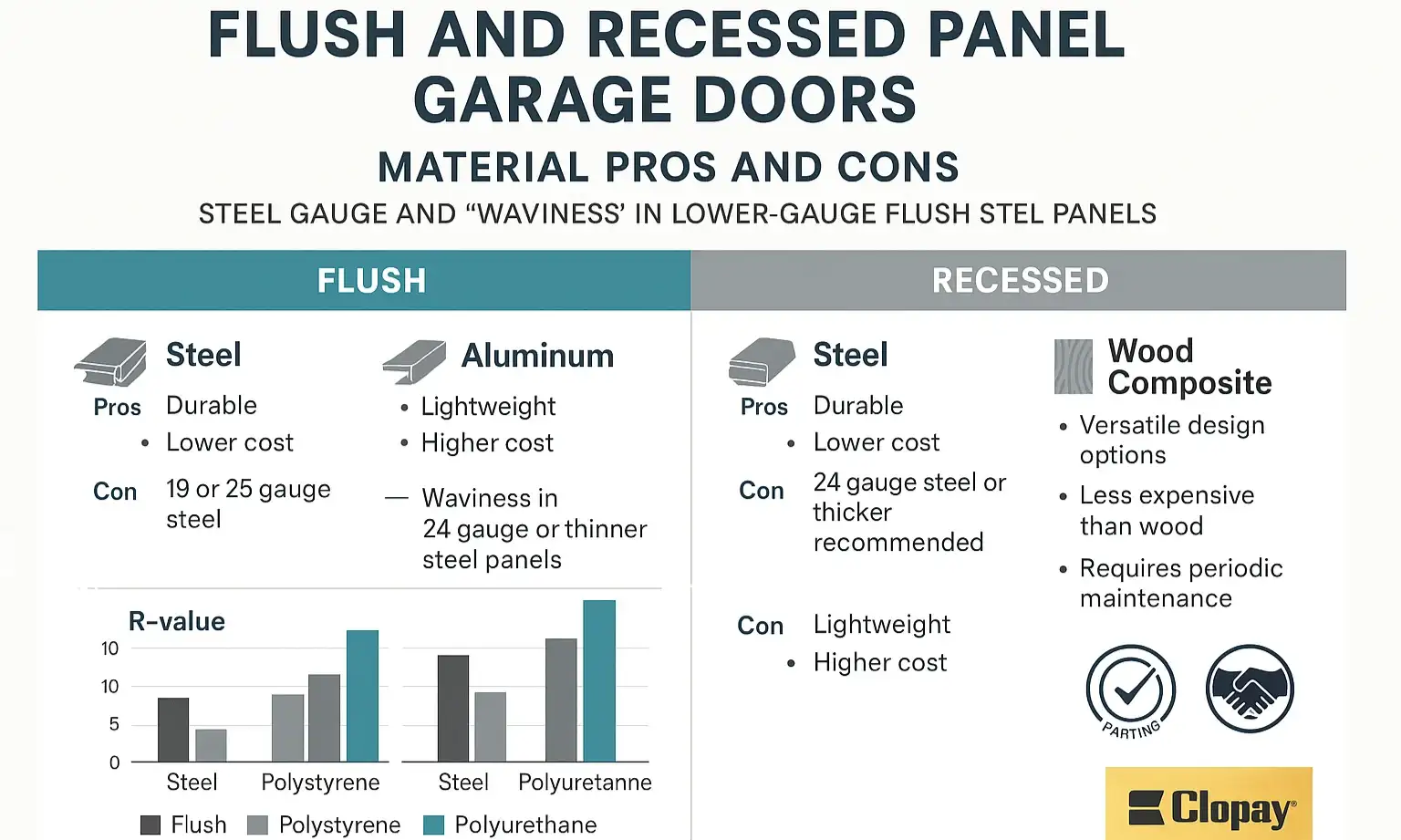
Choosing a panel style is step one. Understanding how materials and construction affect that style is where you make a truly informed decision that balances aesthetics with long-term value. Exploring the latest garage door trends shows a clear move towards durability and thermal efficiency.
The Material Question: Steel, Aluminum, and Wood Composites
The material you choose dramatically impacts the final look and performance of your door.
Architect’s Corner: The Truth About Steel Flush Panels & “Oil Canning”
Here’s an insider tip you won’t find in most sales brochures. Large, flat steel flush panels, especially in darker colors exposed to direct sun, can sometimes exhibit a phenomenon called “oil canning.” This is a perceived waviness or distortion in the flat areas of the metal. It’s not a structural defect but an inherent characteristic of light-gauge sheet metal.
How to mitigate it? Opting for a thicker gauge steel (a lower number means a thicker panel) or choosing a door with light texturing can help minimize its appearance. This is a crucial, candid piece of information that separates a purely aesthetic choice from a practical, long-term investment.
Here’s an insider tip you won’t find in most sales brochures. Large, flat steel flush panels, especially in darker colors exposed to direct sun, can sometimes exhibit a phenomenon called “oil canning.” This is a perceived waviness or distortion in the flat areas of the metal. It’s not a structural defect but an inherent characteristic of light-gauge sheet metal.
How to mitigate it? Opting for a thicker gauge steel (a lower number means a thicker panel) or choosing a door with light texturing can help minimize its appearance. This is a crucial, candid piece of information that separates a purely aesthetic choice from a practical, long-term investment.
Insulation’s Impact on Comfort and Durability
A garage door is a huge part of your home’s thermal envelope. The decision between an insulated vs non insulated garage door is critical, especially if you have living space above or adjacent to the garage. Both flush and recessed panel doors are available with high R-value insulation. A well-insulated door not only saves energy but also feels more solid, operates more quietly, and is more resistant to dents. Given the climate, selecting from quality insulated garage doors connecticut providers is a smart move for any homeowner in the region. There are many garage door insulation types, and understanding them is key to making the right choice.
Your Decision Checklist: Flush or Recessed?
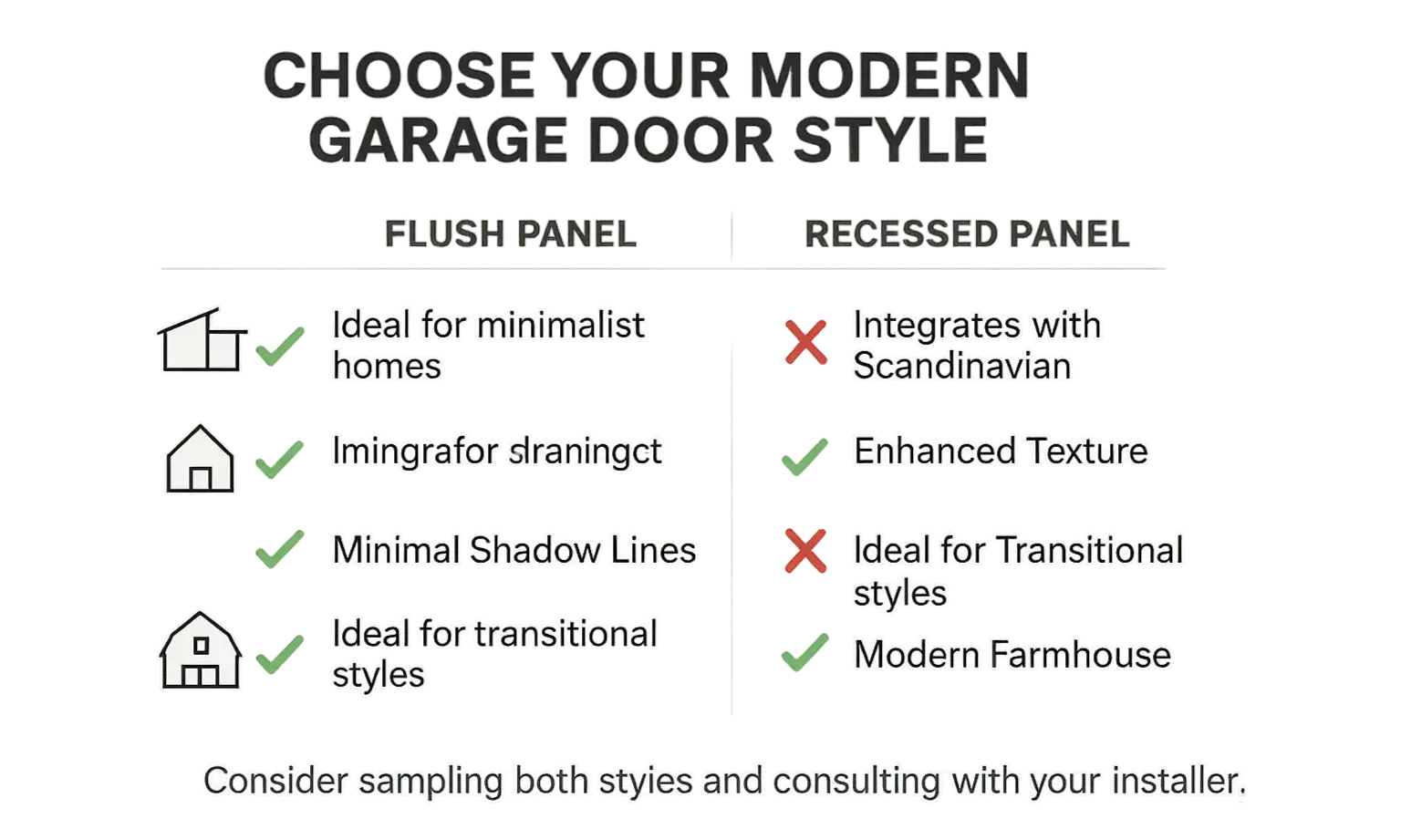
Feeling clearer? Let’s distill everything into a simple checklist to help guide your decision.
Choose a Flush Panel Door if…
Choose a Recessed Panel Door if…
Frequently Asked Questions
Are flush panel doors more expensive than recessed panel doors?
Generally, for the same material, size, and insulation level, the cost difference is minimal. The final price is driven more by the material (steel vs. aluminum vs. wood composite), insulation R-value, and any custom options like windows or hardware.
Which style is easier to maintain?
Both are quite easy to maintain. However, the smooth surface of a flush panel door can be slightly quicker to wipe down, while the indentations on a recessed panel door may collect a bit more dust in their corners.
Can I get windows in both flush and recessed panel doors?
Absolutely. Adding a row of windows is one of the most popular customizations for modern garage doors. For flush panels, a clean row of vertical windows on one side (a vertical lite) is a very popular modern look. For recessed panels, windows are often sized to fit within the top panel sections, maintaining the door’s geometric harmony.
Does “long panel” or “short panel” apply to both styles?
This terminology is primarily associated with recessed and raised panel doors. A “long panel” door would have one large rectangular recess per section, while a “short panel” would have two or more. For flush doors, the concept doesn’t apply as the surface is uniform. However, the overall sections or “planks” of the door can be laid out horizontally or even vertically to create a different effect.
Your Home's Façade, Redefined
Your garage door is too important to be an afterthought. By understanding the subtle yet powerful differences between flush and recessed panels, you can transform it into a key feature that completes your home’s architectural vision. The choice is no longer just about function; it’s about speaking the same design language as the rest of your home, creating a curb appeal that is intentional, cohesive, and beautifully modern.
Frequently Asked Questions
Are flush panel doors more expensive than recessed panel doors?
Generally, for the same material, size, and insulation level, the cost difference is minimal. The final price is driven more by the material (steel vs. aluminum vs. wood composite), insulation R-value, and any custom options like windows or hardware.
Which style is easier to maintain?
Both are quite easy to maintain. However, the smooth surface of a flush panel door can be slightly quicker to wipe down, while the indentations on a recessed panel door may collect a bit more dust in their corners.
Can I get windows in both flush and recessed panel doors?
Absolutely. Adding a row of windows is one of the most popular customizations for modern garage doors. For flush panels, a clean row of vertical windows on one side (a vertical lite) is a very popular modern look. For recessed panels, windows are often sized to fit within the top panel sections, maintaining the door's geometric harmony.
Does "long panel" or "short panel" apply to both styles?
This terminology is primarily associated with recessed and raised panel doors. A "long panel" door would have one large rectangular recess per section, while a "short panel" would have two or more. For flush doors, the concept doesn't apply as the surface is uniform. However, the overall sections or "planks" of the door can be laid out horizontally or even vertically to create a different effect.