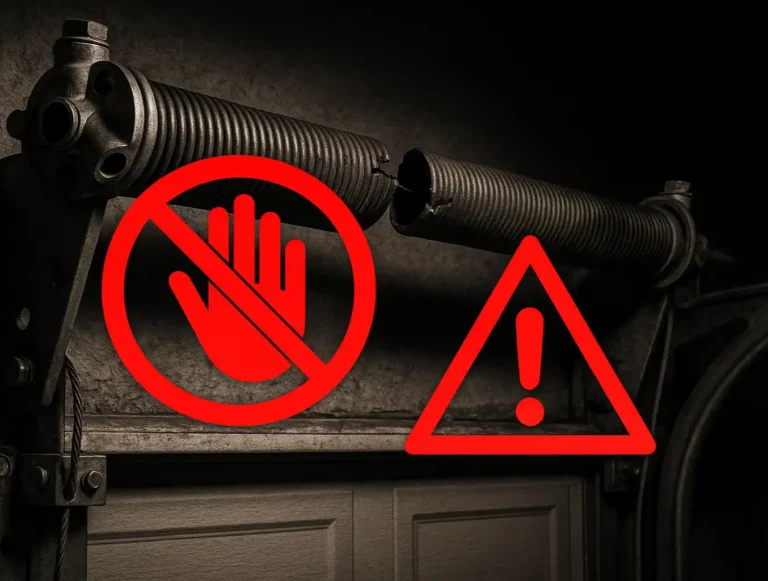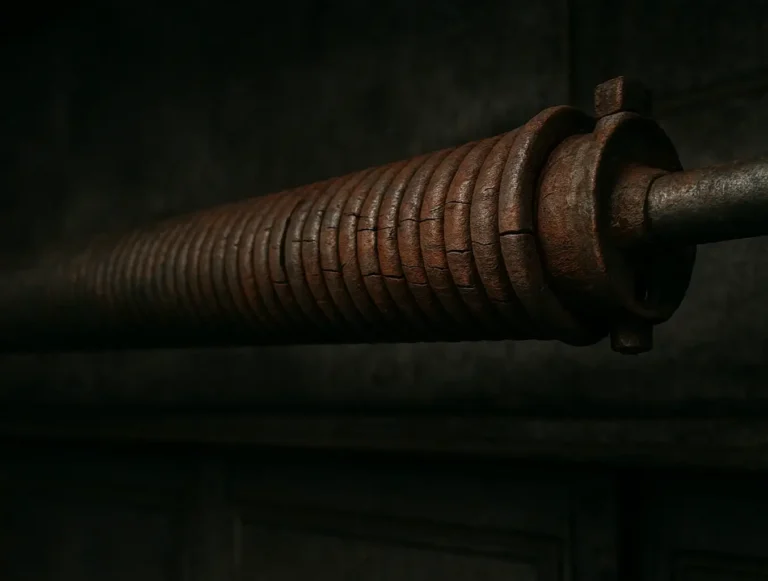
Every year, an estimated 20,000 to 30,000 people are injured by their garage doors. It’s a shocking number for an appliance we use daily without a second thought. While we might worry about a door closing on something, the most severe risks are often hidden in plain sight, coiled tightly in the springs that do the heavy lifting.
You’ve likely landed here because you’re a curious homeowner. Maybe your garage door is acting up, and you’re wondering, “Can I fix this myself?” You’ve probably heard there are two main types of springs—torsion and extension—but the difference seems purely mechanical.
The truth is, understanding the difference isn’t just about mechanics; it’s about safety. Torsion and extension springs fail in dramatically different ways, and each presents a unique, significant danger to the unprepared DIYer. This isn’t a simple repair; it’s a rendezvous with hundreds of pounds of stored energy. Let’s break down what that energy looks like and why it demands respect.
A Tale of Two Springs: The Hidden Dangers of Your Garage Door
Published: Jan 9, 2026 | Updated: Jul 28, 2026
The Two Kinds of Power: Twisting vs. Stretching
Before we dive into the dangers, we need to understand the basic physics at play. Both spring systems are designed to counterbalance the immense weight of your garage door, making it light enough to be lifted by you or a small motor. But they store and release that energy in completely different ways.
Now, let’s look at what happens when that stored energy is released unexpectedly.
The Anatomy of Danger: Torsion Springs
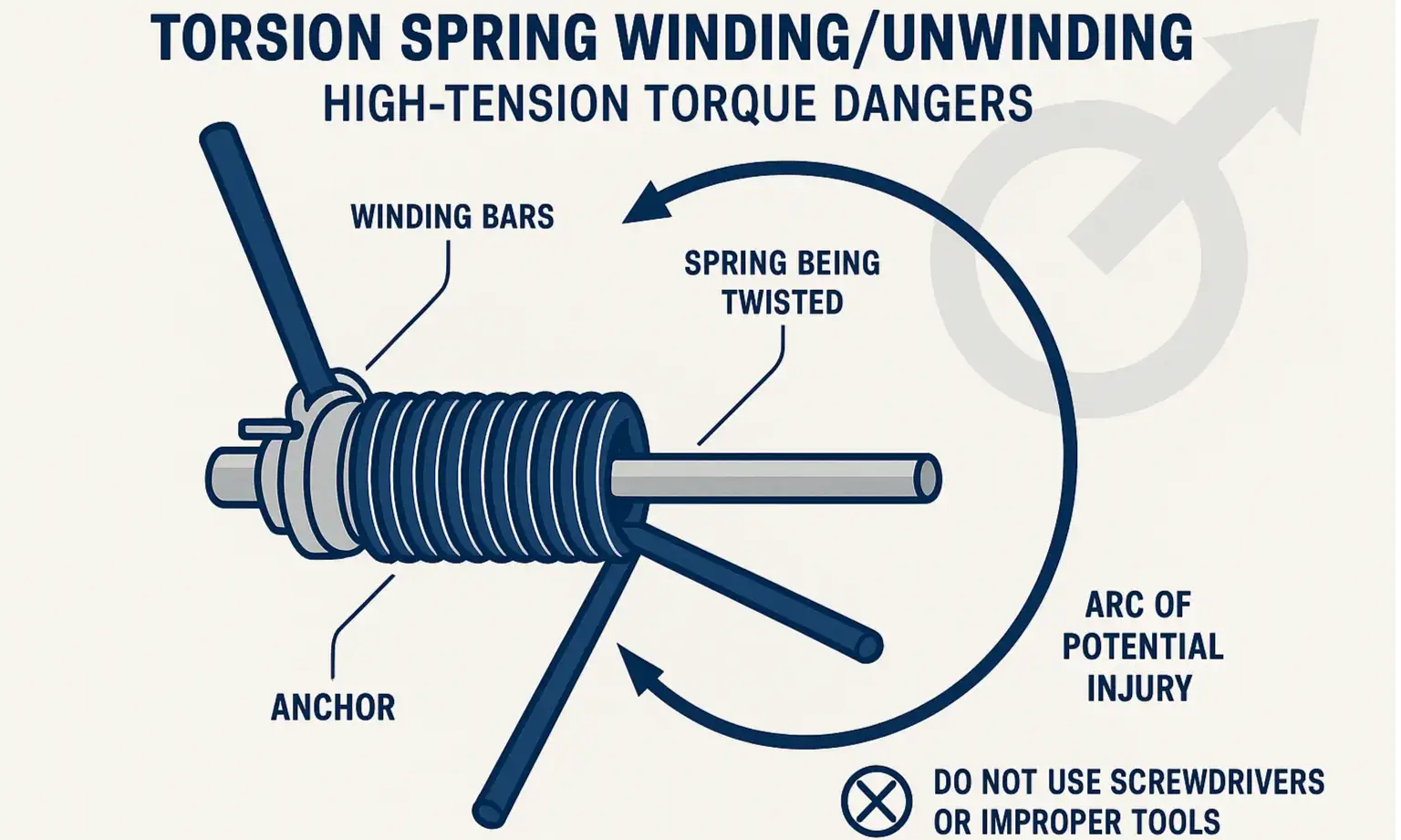
The primary danger of a torsion spring isn’t when it breaks—it’s when you try to install or adjust it. These springs are loaded with an incredible amount of torque. A single spring for a standard two-car garage can be wound to lift over 300 pounds. The process of winding or unwinding this spring is where most catastrophic accidents happen.
The winding process: a high-stakes operation
To adjust a torsion spring, you need two specialized tools called winding bars. These are solid steel rods that fit perfectly into the winding cone of the spring. The process involves placing one bar in a hole, turning it a quarter turn to take the tension, inserting the second bar to hold it, and repeating this sequence.
Here’s where it goes wrong:
While a torsion spring breaking on its own is loud and startling, it’s generally contained on its shaft. The true, visceral danger lies in the hands-on process of managing its immense, coiled power.
The Anatomy of Danger: Extension Springs
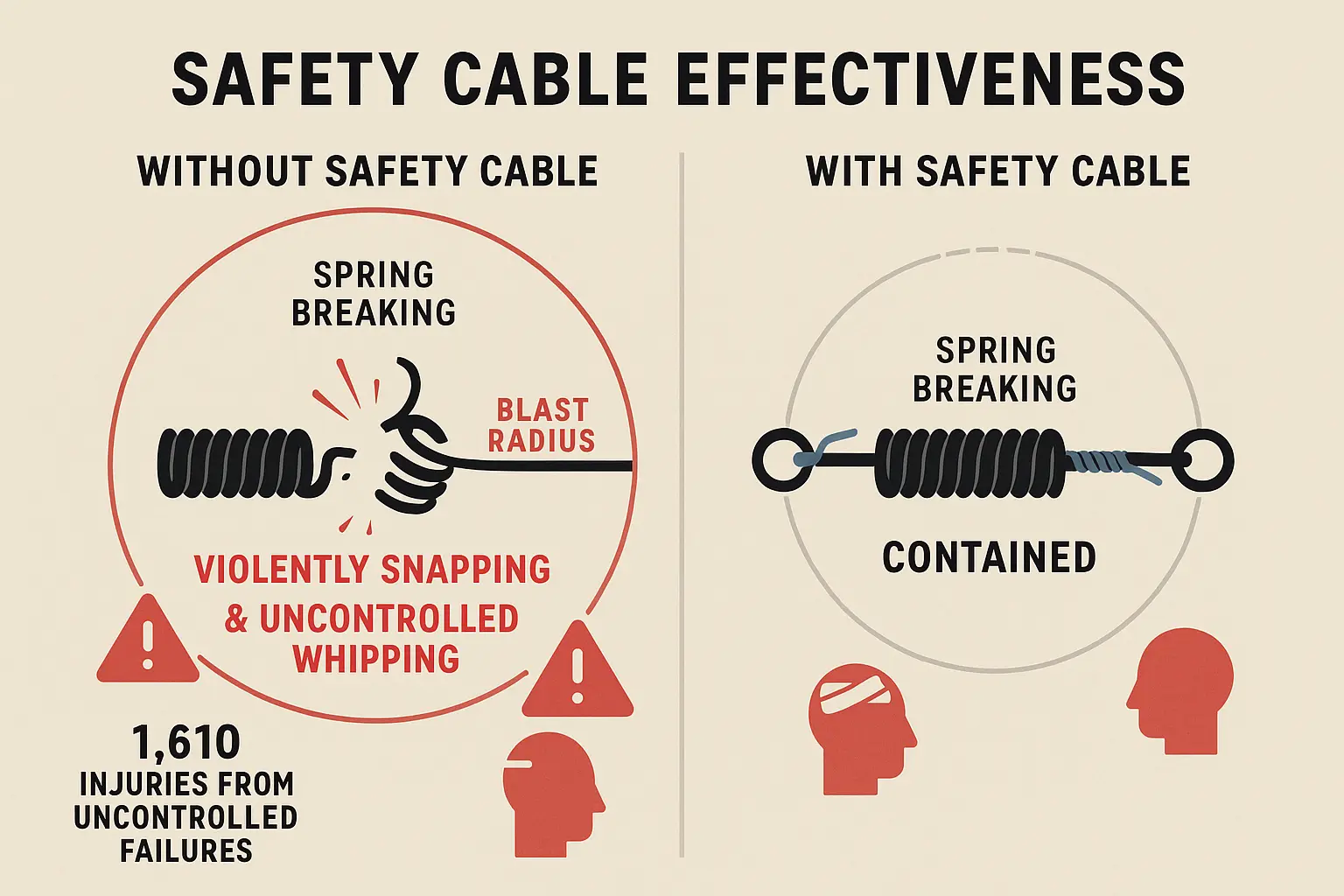
If torsion springs are a controlled beast you must tame, extension springs are a wild animal that can snap its leash at any moment. The primary danger of an extension spring system is not during adjustment but at the moment of failure.
The breakage: a high-velocity projectile
Over time, the constant stretching and contracting causes metal fatigue. When an extension spring finally breaks, it unleashes all its stored energy in an instant. Without a crucial safety feature, the broken spring and any attached hardware can become a dangerous projectile.
The danger with extension springs is less about the process and more about the sudden, violent moment of failure. The presence and proper installation of safety cables are the only things standing between a simple mechanical failure and a trip to the emergency room.
Mastery: Safety Comparison Matrix
To make the choice clearer, let’s compare the two systems side-by-side from a purely safety-focused perspective.
Primary Danger
Torsion Spring System: High-torque energy release during winding/unwinding.
Extension Spring System: Uncontrolled projectile motion upon breakage.
Failure Mode
Torsion Spring System: Usually a loud bang. The spring stays on the shaft.
Extension Spring System: The spring can snap and fly across the garage if not restrained.
DIY Risk Level
Torsion Spring System: Extremely High. The process itself is the most dangerous part.
Extension Spring System: High. Danger is passive until the moment of failure.
Essential Safety Gear
Torsion Spring System: Solid steel winding bars (not screwdrivers), safety glasses, gloves.
Extension Spring System: Safety cables installed correctly through the spring’s center.
Common Injuries
Torsion Spring System: Blunt force trauma, broken bones, head injuries from flying winding bars.
Extension Spring System: Lacerations, puncture wounds, and severe eye injuries from flying spring parts.
Action: The DIY Safety Checklist
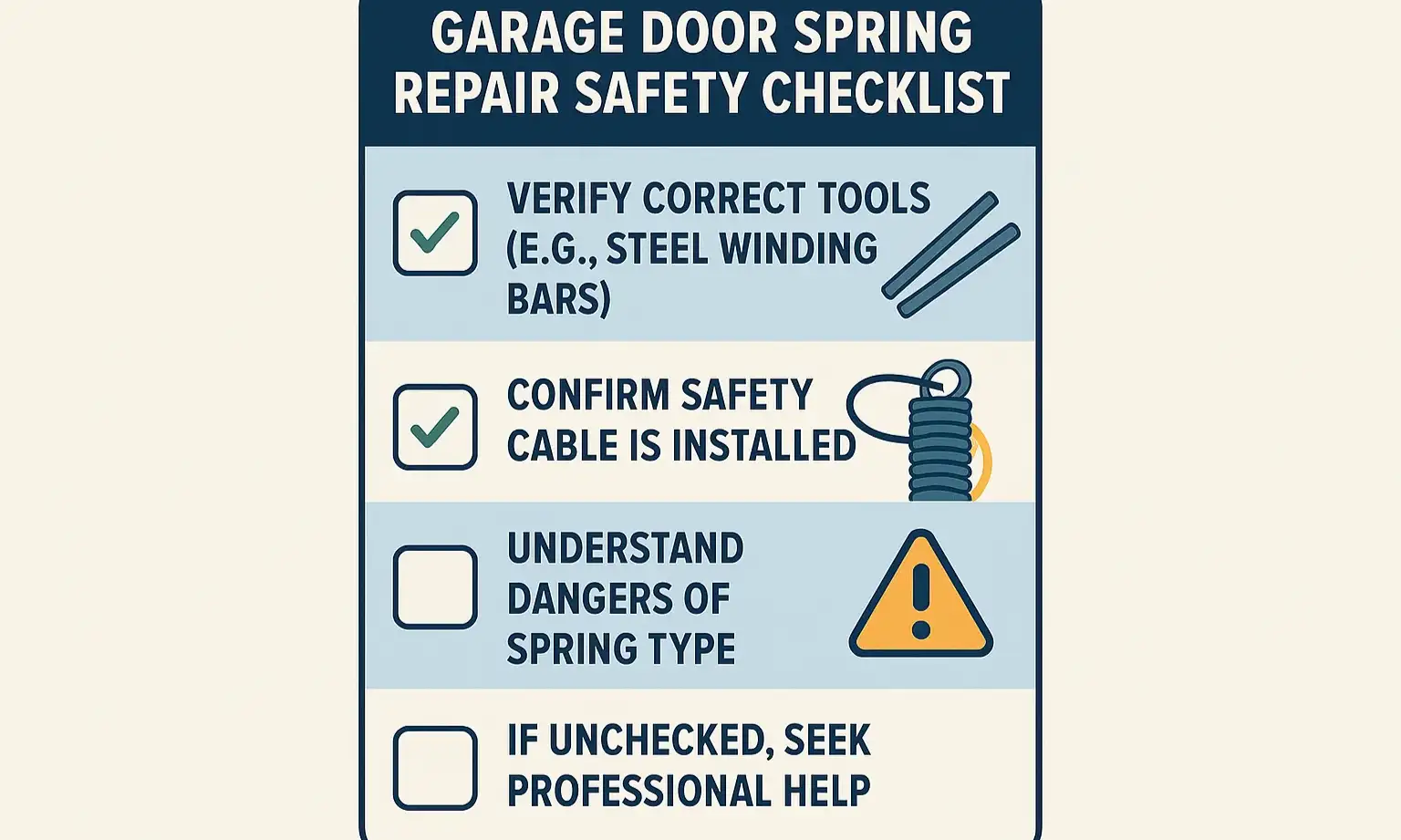
If you are still considering tackling this job yourself, pause. Go through this checklist honestly. If you can’t answer “yes” to every single point, your safest move is to call a professional.
Your next step is a safe one
Your garage door is the largest moving object in your home. The springs that operate it are not just simple parts; they are reservoirs of immense energy. While the spirit of DIY is commendable, some jobs carry risks that far outweigh the potential savings.
Understanding the unique dangers of torsion and extension springs isn’t about scaring you—it’s about empowering you to make a genuinely informed and safe decision for yourself and your family.
Frequently Asked Questions
Can I replace a garage door spring myself?
While it is physically possible, it is not recommended for homeowners. The risks, especially with torsion springs, are extremely high. The specialized tools and knowledge required to perform the job safely are typically only possessed by trained professionals.
Which spring system is safer overall?
A professionally installed torsion spring system is generally considered safer. Because the spring is contained on a shaft, it is less likely to become a projectile if it breaks. However, the installation and adjustment process for torsion springs is far more dangerous than for extension springs.
My extension springs don’t have safety cables. Is that a big deal?
Yes, it is a critical safety issue. Without safety cables, a breaking extension spring has nothing to stop it from flying across your garage. Installing safety cables is an essential measure to prevent property damage and serious injury.
How do I know what kind of spring I have?
Look above your garage door. If you see one or two large, coiled springs on a metal shaft, you have a torsion system. If you see long, thinner springs running parallel to the horizontal door tracks on each side, you have an extension system.
Frequently Asked Questions
Can I replace a garage door spring myself?
While it is physically possible, it is not recommended for homeowners. The risks, especially with torsion springs, are extremely high. The specialized tools and knowledge required to perform the job safely are typically only possessed by trained professionals.
Which spring system is safer overall?
A professionally installed torsion spring system is generally considered safer. Because the spring is contained on a shaft, it is less likely to become a projectile if it breaks. However, the installation and adjustment process for torsion springs is far more dangerous than for extension springs.
My extension springs don't have safety cables. Is that a big deal?
Yes, it is a critical safety issue. Without safety cables, a breaking extension spring has nothing to stop it from flying across your garage. Installing safety cables is an essential measure to prevent property damage and serious injury.
How do I know what kind of spring I have?
Look above your garage door. If you see one or two large, coiled springs on a metal shaft, you have a torsion system. If you see long, thinner springs running parallel to the horizontal door tracks on each side, you have an extension system.