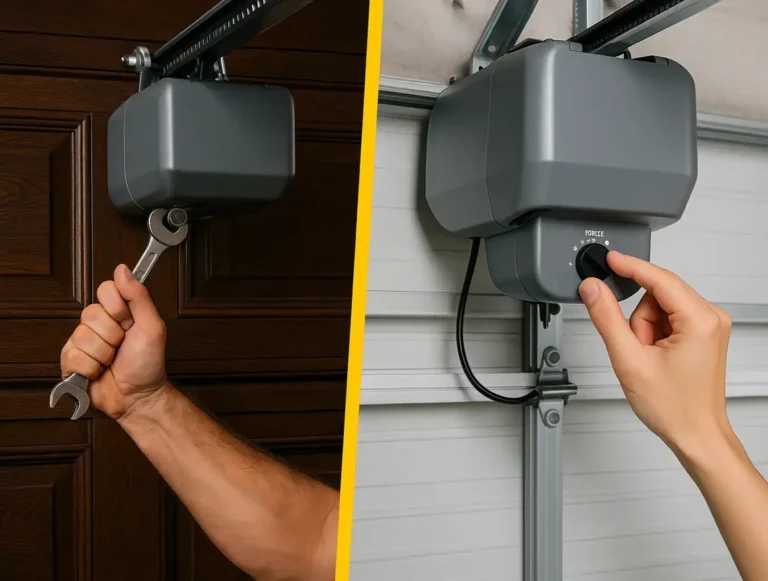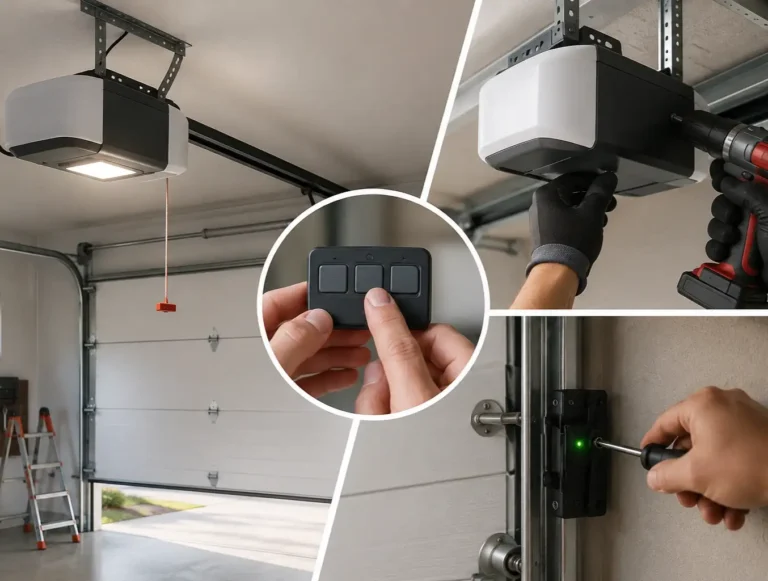
You did everything right. You looked up a guide, grabbed a screwdriver, and tweaked the settings on your garage door opener. But instead of fixing the problem, you made it worse. Now, the door hits the floor and immediately reverses, or it struggles and gives up halfway. It’s a frustrating scenario that leaves many homeowners feeling stuck.
If this sounds familiar, take a deep breath. You’re not alone, and you haven’t broken anything. You’ve just stumbled upon one of the most misunderstood aspects of garage door mechanics. The problem isn’t that you didn’t adjust it enough—it’s that you likely adjusted it in the wrong direction.
This guide is for you. It’s the next chapter for when the basic fixes fail. We’ll walk through why this happens and how to perform a simple recalibration that solves the problem for good.
Troubleshooting Garage Door Opener Force Reversal Issues
Published: Apr 20, 2026 | Updated: Jul 28, 2026
Foundation: The 3-Way Relationship: Travel, Force, and Obstructions
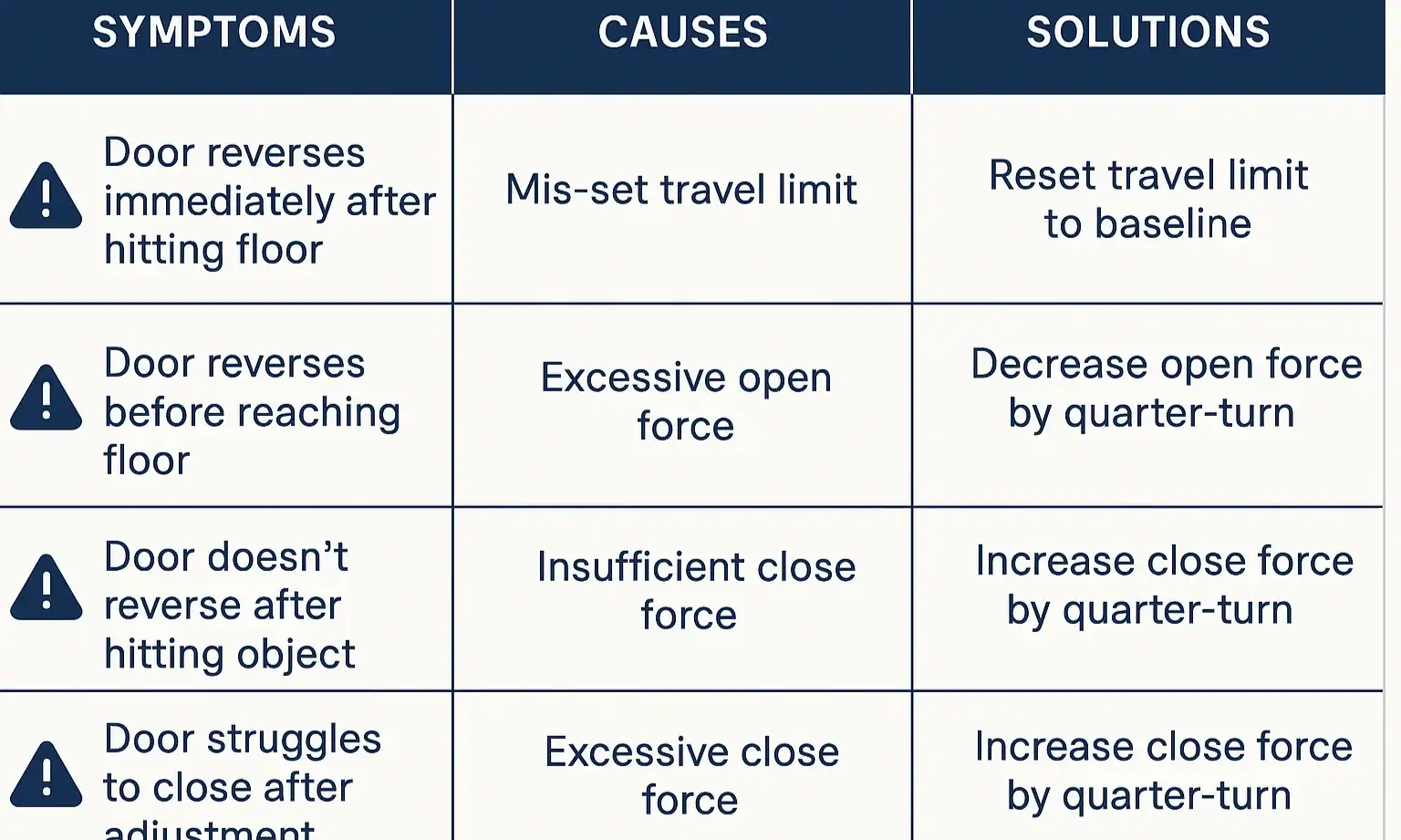
The key to solving this puzzle is understanding how your garage door opener “thinks.” It relies on two critical settings that work together: the Down Travel Limit and the Close Force.
Here’s the “aha moment”: When a garage door reverses after hitting the floor, it’s because the Down Travel Limit is set too low. The opener is trying to push the door through the concrete floor. Because it can’t, the motor works harder, exceeds the limit set by the Close Force, and triggers the safety reversal. It thinks the floor is an obstacle.
The common mistake is to increase the Close Force, thinking the door just needs more power. This is not only incorrect but can be dangerous, as it might cause the door to damage itself or fail to reverse for a real obstruction.
The solution is almost always counter-intuitive: you need to reduce the down travel, telling the door to stop a fraction of an inch higher. A proper garage door adjustment focuses on precision, not power.
The common mistake is to increase the Close Force, thinking the door just needs more power. This is not only incorrect but can be dangerous, as it might cause the door to damage itself or fail to reverse for a real obstruction.
The solution is almost always counter-intuitive: you need to reduce the down travel, telling the door to stop a fraction of an inch higher. A proper garage door adjustment focuses on precision, not power.
Building: The 2-Minute Diagnostic Test
Before you touch any screws, let’s confirm you’re on the right track. This simple test isolates the problem and tells you if the issue is with the settings or the safety sensors.
The “Hold the Wall Button” Test:
Press and hold the button on your wall-mounted control panel. Don’t use the remote. If the door closes completely as long as you hold the button down, you’ve confirmed two things:
If the door closes with this test, you’re ready to recalibrate. If it still struggles, stops, or makes grinding noises, you may have a deeper mechanical issue that requires a professional inspection. The first step in any attempt to fix a garage door opener is a correct diagnosis.
Mastery: The Step-by-Step Recalibration Process
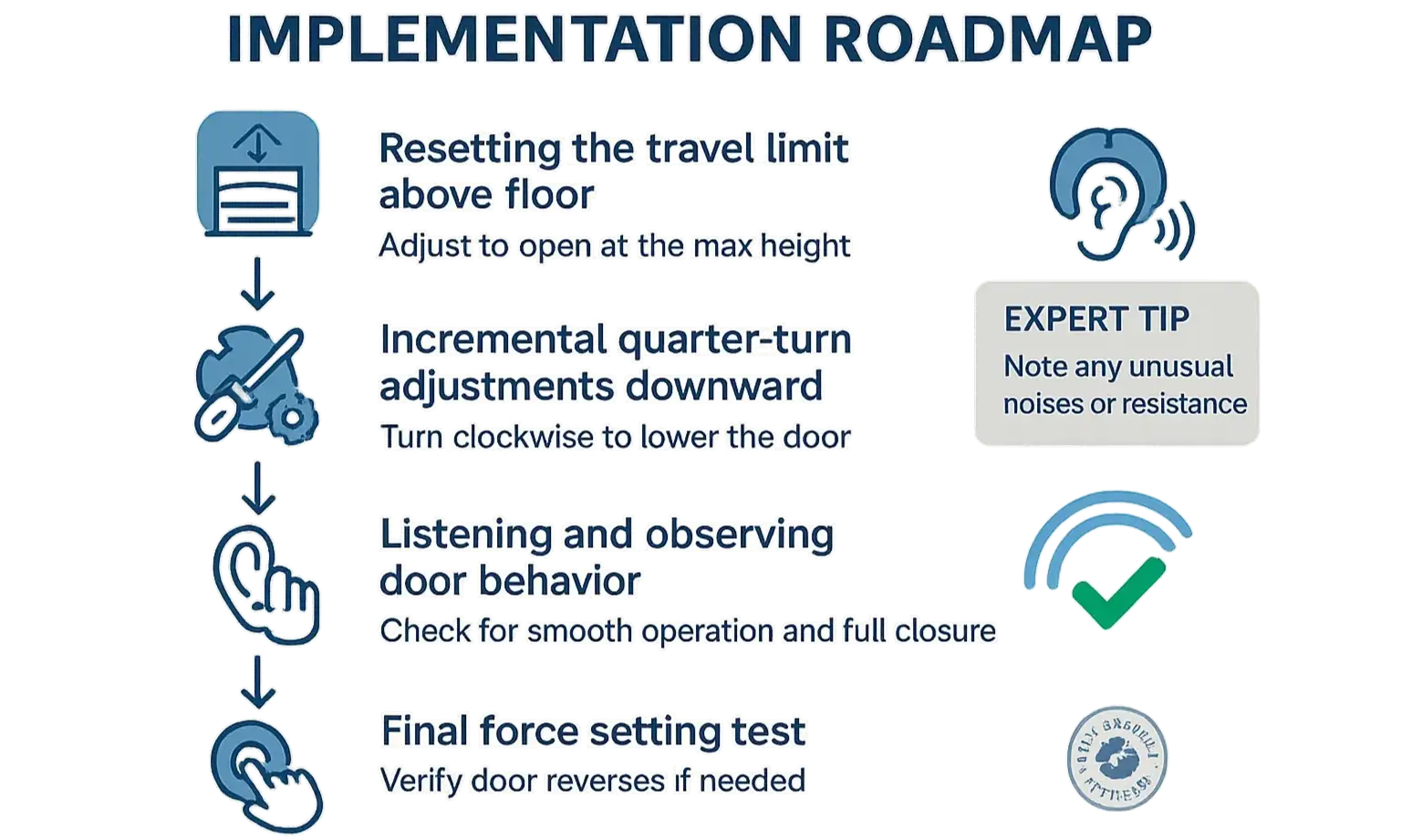
This process is about making small, incremental changes. We’ll reset the door to a known good state and then fine-tune it perfectly. You’ll likely need a small flathead screwdriver or a nut driver, depending on your opener model.
Step 1: Reset the Baseline (Go Up Before You Go Down)
First, we need to get the door to stop before it hits the floor. Locate the “Down” or “Close” travel adjustment screw on your opener motor.
This is your new, safe starting point.
Step 2: The Art of the Quarter-Turn
Now, we’ll bring the door down to the floor with precision.
❌ Common Mistake: Turning the adjustment screw a full rotation at a time. This makes it impossible to find the sweet spot and often leads you to overshoot the target. Patience and small adjustments are key.
Step 3: Observe and Listen for the Perfect Seal
As the door gets closer to the floor, pay close attention. A correctly set door will:
When It's Still Not Working: Advanced Scenarios & Calling a Pro
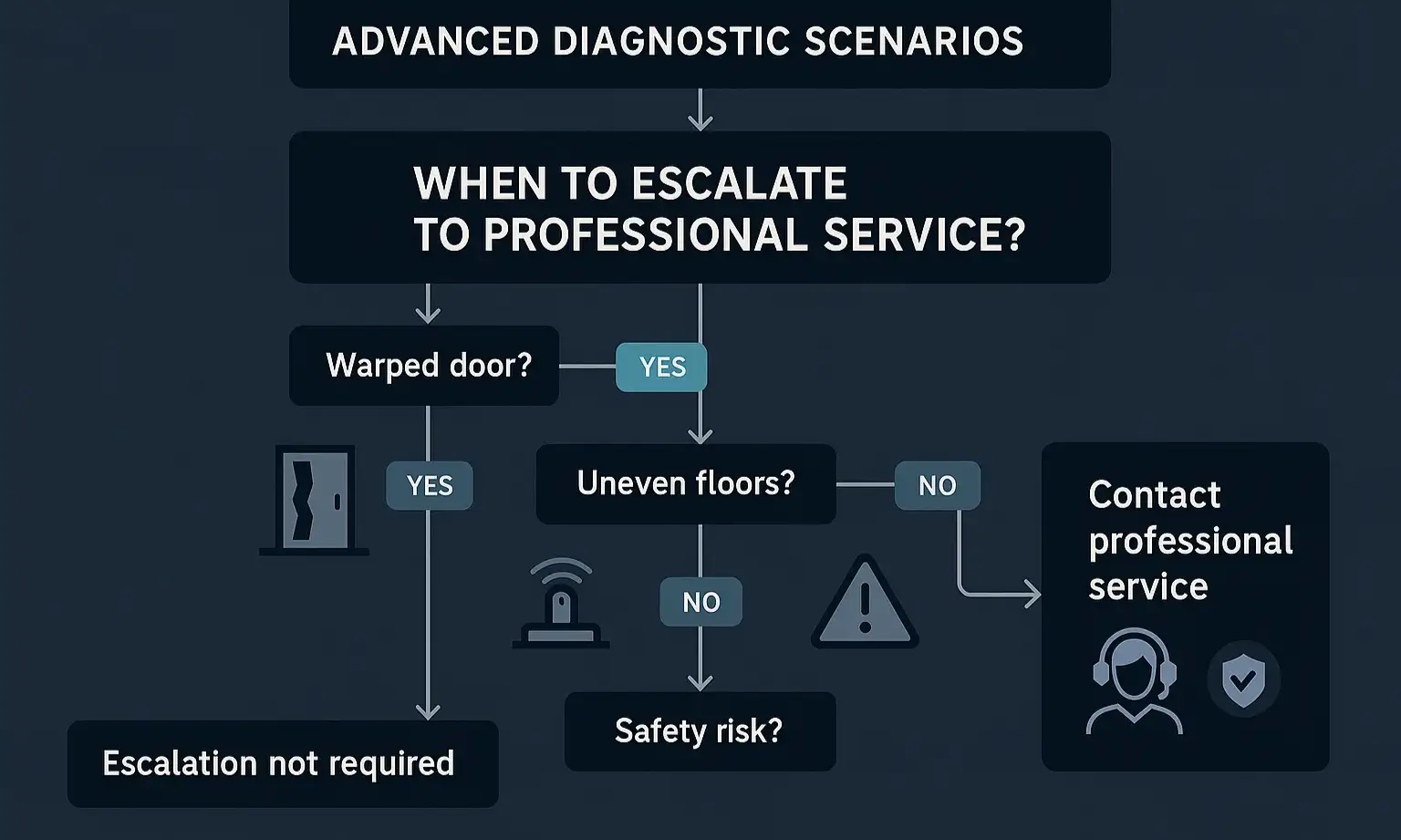
If you’ve followed the recalibration process and the door still won’t close correctly, an underlying issue may be complicating the problem.
If you suspect any of these issues, it’s time to stop and call for professional help. A trained technician can diagnose the root cause safely and prevent further damage to your opener or door.
Frequently Asked Questions
What’s the difference between the travel limit and the force setting?
The travel limit is about distance—it tells the door where to stop. The force setting is about pressure—it tells the door when to give up and reverse if it meets resistance. You should always set the travel limit correctly first, then test the force.
Why does my garage door close if I hold the button down?
Holding the wall button overrides the safety reversal system (both the photo-eye sensors and the force sensor). This is a built-in feature for closing the door in an emergency. The fact that it works this way is your clue that the problem is with a safety feature, not the motor itself.
Could my safety sensors still be the problem?
Yes, but the symptoms are usually different. If the door reverses mid-way down for no apparent reason, it’s almost always a sensor issue. If it reverses only after hitting the floor, the travel limit is the most likely culprit.
My opener is making a beeping noise now. What does that mean?
A beeping noise is often a diagnostic code from the opener. The meaning varies by brand, but it frequently indicates issues with battery backup systems or logic board errors. If you’re hearing a persistent garage door opener beeping, consult your manual or a technician.
What happens if I’ve disengaged my garage door from the opener?
If you’ve pulled the emergency release cord, you’ll need to reconnect it before testing the opener settings. In most cases, you can simply run the opener until the trolley connects with the carriage on the door. If you’re having trouble, our guide on how to handle a garage door opener disengage can walk you through the steps.
Frequently Asked Questions
What's the difference between the travel limit and the force setting?
The travel limit is about distance—it tells the door where to stop. The force setting is about pressure—it tells the door when to give up and reverse if it meets resistance. You should always set the travel limit correctly first, then test the force.
Why does my garage door close if I hold the button down?
Holding the wall button overrides the safety reversal system (both the photo-eye sensors and the force sensor). This is a built-in feature for closing the door in an emergency. The fact that it works this way is your clue that the problem is with a safety feature, not the motor itself.
Could my safety sensors still be the problem?
Yes, but the symptoms are usually different. If the door reverses mid-way down for no apparent reason, it's almost always a sensor issue. If it reverses only after hitting the floor, the travel limit is the most likely culprit.
My opener is making a beeping noise now. What does that mean?
A beeping noise is often a diagnostic code from the opener. The meaning varies by brand, but it frequently indicates issues with battery backup systems or logic board errors. If you're hearing a persistent garage door opener beeping, consult your manual or a technician.
What happens if I've disengaged my garage door from the opener?
If you've pulled the emergency release cord, you'll need to reconnect it before testing the opener settings. In most cases, you can simply run the opener until the trolley connects with the carriage on the door. If you're having trouble, our guide on how to handle a garage door opener disengage can walk you through the steps.